It's hard to get anywhere in Rome without coming across a church, so it's not too hard to find a place to attend worship. However, if your primary language is anything other than Italian and if you're anything other than Roman Catholic, things get a lot harder. Since we're English-speaking Protestants, we're trying to find a worship community where we feel like we belong, at least for the time being.
Last week, we attended church at Santa Susanna, the official American National Catholic church in Rome as designated by the Pope. They are funded neither by American nor Italy, but instead exist under permission of the church to function as if they were an American church. Their facility is a beautiful, ancient building, with parts dating back as far as 280 AD. Their service was very contemporary, using Marty Haugen among other more recent liturgical artists. The sermon was simple, straight-forward, and accessible.
This past Sunday, we decided to try something a little different and went to St. Paul's Inside The Walls, the American Episcopalian church in Rome. They are the first non-Catholic church built inside Rome. Interestingly enough, this service was more high church than the Catholic church the week previous; this probably owed partly to the Bishop's attendance at worship that day. His sermon was extremely calm (almost to where I tuned him out) and very intellectual. The church itself was a sort of modern take on ancient art, with gorgeous mosaics and sculpture inside.
What struck me most about these two congregations is the way they defined themselves within their contexts. Santa Susanna certainly has the advantage by way of its denomination, since the Catholic church has much more support within the country. However, it seemed to also have a stronger sense of integration; instead of defining itself against its surroundings, it placed itself strongly within it. It embraces its ancient history while remaining extremely accessible for all sorts of visitors (since even its regular worshiping body doesn't come close to those visiting) regardless of language or even denomination.
St. Paul's, on the other hand, didn't seem to strike the same balance. Their bulletin opened with Luke 4:24, as if we worshipped in Rome because we weren't welcome at home. Even the closing hymn made explicit mention of the call for evangelists to save Europe, as Paul did once before and we were to do now. Instead of helping us feel welcomed and adjusted, it reminded us so strongly of the foreignness of our surroundings.
Churches in general are out-of-place no matter where they land. Therefore, a congregation must decide how it will adapt and adjust in light of the peculiarities of whatever city (or lack thereof) it finds itself in. English-speaking and/or Protestant churches here in Rome seem to drive that point home. I look forward to continuing participation in their services and seeing how they find sense of self and strong proclamation in this sometimes challenging context.
Sunday, February 4, 2007

Friday, February 2, 2007
La Scala Sancta
So Jesus came out, wearing the crown of thorns and the purple robe. Pilate said to them, "Here is the man!" When the chief priests and the police saw him, they shouted, "Crucify him! Crucify him!" Pilate said to them, "Take him yourselves and crucify him; I find no case against him." - John 19: 5-6
According to church tradition, the Scala Sancta (Holy Stairs) are the steps that led up to the praetorium of Pilate in Jerusalem, which Christ stood on and was condemned during his passion. They reached Rome around 326 when St. Helena, mother of Constantine, had them brought back from the Holy Land. The stairs were moved a few times, but reached their current location outside S. Giovanni in Laterno near the end of the 16th century.
Currently, the marble steps are covered with walnut wood to protect the steps - and, perhaps, be a bit more forgiving on pilgrims who climb the 28 steps on their knees. The stairs lead up to the Sancta Sanctorum (Holy of Holies), an old papal chapel which is the only remaining part of the former Lateran Palace. It contains several relics and a icon of Jesus that is said to have been made 'not by human hands'.
For centuries, pilgrims have climbed these stairs on their knees. In the Catholic church, plenary indulgence can be granted for climbing the stairs, especially in Lent and on Fridays. Not realizing this when we climbed the stairs ourselves, we met a huge crowd of people. Several nuns, but a surprising number of lay people. Some of them were extremely devout, pausing for lengthy prayers, bending to kiss certain steps, or using prayer books and other devotional aids to make the most of their experience.
From a Lutheran perspective, these stairs gained infamy when Martin Luther climbed them 500 years ago, praying for the souls of his grandparents. When he reached the top, he famously wondered if it all meant nothing. His trip to Rome was clouded by doubts - about the church, about his faith, about indulgences, and more. For him, the religious experience of the Scala Sancta was not buying a soul out of purgatory - something that could not be done - but about reawakening his own Biblical faith.
As a modern Lutheran pilgrim, I did not hope for indulgences or favors. I only wanted to join brothers and sisters in faith in an important experience. For me, it was enough to be reminded of Christ's passion, to spend time on my knees, and to be in a holy place consecrated by prayers and devotion, no matter the reason or intent.
Gracious God, we know that we are saved by grace through faith in your Son, Jesus Christ. Keep us ever aware of his sacrifice, and join us with the faithful in prayer and devotion to you always. We pray these things in your name, Amen.
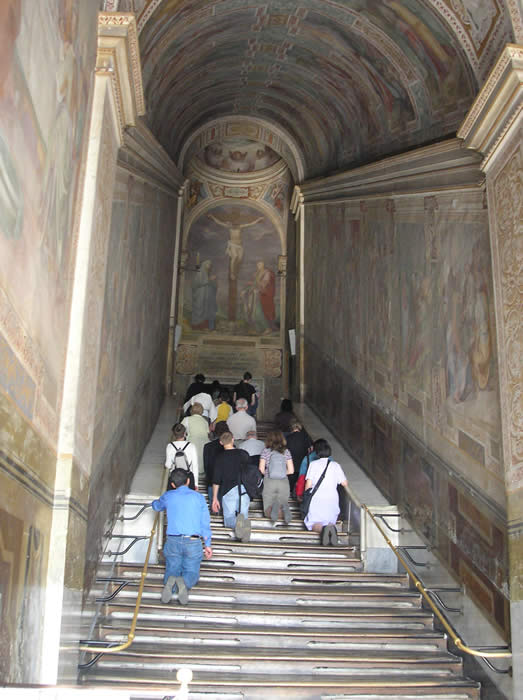
According to church tradition, the Scala Sancta (Holy Stairs) are the steps that led up to the praetorium of Pilate in Jerusalem, which Christ stood on and was condemned during his passion. They reached Rome around 326 when St. Helena, mother of Constantine, had them brought back from the Holy Land. The stairs were moved a few times, but reached their current location outside S. Giovanni in Laterno near the end of the 16th century.
Currently, the marble steps are covered with walnut wood to protect the steps - and, perhaps, be a bit more forgiving on pilgrims who climb the 28 steps on their knees. The stairs lead up to the Sancta Sanctorum (Holy of Holies), an old papal chapel which is the only remaining part of the former Lateran Palace. It contains several relics and a icon of Jesus that is said to have been made 'not by human hands'.
For centuries, pilgrims have climbed these stairs on their knees. In the Catholic church, plenary indulgence can be granted for climbing the stairs, especially in Lent and on Fridays. Not realizing this when we climbed the stairs ourselves, we met a huge crowd of people. Several nuns, but a surprising number of lay people. Some of them were extremely devout, pausing for lengthy prayers, bending to kiss certain steps, or using prayer books and other devotional aids to make the most of their experience.
From a Lutheran perspective, these stairs gained infamy when Martin Luther climbed them 500 years ago, praying for the souls of his grandparents. When he reached the top, he famously wondered if it all meant nothing. His trip to Rome was clouded by doubts - about the church, about his faith, about indulgences, and more. For him, the religious experience of the Scala Sancta was not buying a soul out of purgatory - something that could not be done - but about reawakening his own Biblical faith.
As a modern Lutheran pilgrim, I did not hope for indulgences or favors. I only wanted to join brothers and sisters in faith in an important experience. For me, it was enough to be reminded of Christ's passion, to spend time on my knees, and to be in a holy place consecrated by prayers and devotion, no matter the reason or intent.
Gracious God, we know that we are saved by grace through faith in your Son, Jesus Christ. Keep us ever aware of his sacrifice, and join us with the faithful in prayer and devotion to you always. We pray these things in your name, Amen.
Saturday, January 27, 2007
Santa Maria Sopra Minerva
Charm is deceitful, and beauty is vain, but a woman who fears the Lord is to be praised. Give her a share in the fruit of her hands, and let her works praise her in the city gates. - Proverbs 31:30-31

When we were wandering around exploring some of the ancient and secular sights of Rome, we came across this church in geographic proximity to the Pantheon and decided to check it out. Surprisingly, it was a church I visited on my last trip here five years ago when I was studying medieval women in religious history.
The church boasts several features which make it noteworthy. First, the original structure was built in the first century on top of a temple to Minerva built about 800 years previously. That former structure is gone, and what stands now is Rome's only Gothic-style church built in the mid-13th century. Some theorize that no other Gothic churches exist either because of Rome's decline during that period or because of Italy's distaste for a 'northern' style - regardless, even this church can't quite hold to the Gothic style.
However, what makes this church most remarkable is its dedication to women of religious history. Not only does it supersede the goddess Minerva, but it is the final resting place of Saint Catherine of Siena, an Italian mystic affiliated as a Dominican tertiary who died in Rome in 1380. Her fight to re-unify the Catholic church during the Great Schism. She is one of only three women to receive the title of Doctor of the Church and is also one of the patron saints of Europe. Truly, her faith and testimony are legendary.
It was wonderful for me to come across such a woman of faith again and be reminded of the work that women across the centuries have given to the church. It also made me appreciate the work that I am able to do today and the way I can use my gifts and talents on behalf of the church. Thank you, St. Catherine, and the many women - named and unnamed - who have worked to strengthen the faith.
God of Love, you send us saints of all kinds to guide us in this life towards greater faith in you. We are especially thankful for the women who, against all odds, used their lives and talents to show others your love. Continue to use each of us to our fullest capacity, so that you might be glorified in all the world. In Christ's name we pray, Amen.

When we were wandering around exploring some of the ancient and secular sights of Rome, we came across this church in geographic proximity to the Pantheon and decided to check it out. Surprisingly, it was a church I visited on my last trip here five years ago when I was studying medieval women in religious history.
The church boasts several features which make it noteworthy. First, the original structure was built in the first century on top of a temple to Minerva built about 800 years previously. That former structure is gone, and what stands now is Rome's only Gothic-style church built in the mid-13th century. Some theorize that no other Gothic churches exist either because of Rome's decline during that period or because of Italy's distaste for a 'northern' style - regardless, even this church can't quite hold to the Gothic style.
However, what makes this church most remarkable is its dedication to women of religious history. Not only does it supersede the goddess Minerva, but it is the final resting
 place of Saint Catherine of Siena, an Italian mystic affiliated as a Dominican tertiary who died in Rome in 1380. Her fight to re-unify the Catholic church during the Great Schism. She is one of only three women to receive the title of Doctor of the Church and is also one of the patron saints of Europe. Truly, her faith and testimony are legendary.
It was wonderful for me to come across such a woman of faith again and be reminded of the work that women across the centuries have given to the church. It also made me appreciate the work that I am able to do today and the way I can use my gifts and talents on behalf of the church. Thank you, St. Catherine, and the many women - named and unnamed - who have worked to strengthen the faith.
God of Love, you send us saints of all kinds to guide us in this life towards greater faith in you. We are especially thankful for the women who, against all odds, used their lives and talents to show others your love. Continue to use each of us to our fullest capacity, so that you might be glorified in all the world. In Christ's name we pray, Amen.
Cimitero di Cappuchini
By the sweat of your face you shall eat bread until you return to the ground, for out of it you were taken; you are dust, and to dust you shall return. – Genesis 3:19

A rare, eerie sight awaits under Santa Maria della Concezione, built in 1636.The church was commissioned by Pope Urban XIII, whose brother was a member of the Capuchin order of monks. Five years after the church was built, Cardinal Antonio Barberini (the Pope’s brother – both of a very powerful family) had the bones of thousands friars transferred from the friary into the crypt of this church. Over time, as many as 4,000 people – monks and poor Romans alike – have been interred in the Cimitero di Cappuchini.
However, they are not simply buried.Their bones are artfully arranged in arches, flowers, spirals, and other designs across the walls, arches, and coves of the crypt.Even the lamps are made from various human bones. In some places, the skeletons are kept intact and are wearing F ranciscan habits. Nightly, the monks came down to these crypts to pray and reflect. The last room of the crypt has a sign on the floor reading: "What you are now, we once were; what we are now, you shall be."
While it is certainly macabre and morbid, the sentiment is one of Christians throughout the centuries. This mortal body that we have is only for a time. The world we live in now will pass away. As disconcerting as it is, death happens all the time, all around us – and we would do well to not be afraid of it, but to accept it as part of the life God graciously granted us.
God, our Creator, we know that you have granted us this world only for a short time. Help us to use it well, to your glory, always mindful of the rest that we will finally have in you. Grant us calm hearts without fear, so we can continue to serve you in the time we have here, through your Son, Jesus Christ, our Lord, Amen.

A rare, eerie sight awaits under Santa Maria della Concezione, built in 1636.The church was commissioned by Pope Urban XIII, whose brother was a member of the Capuchin order of monks. Five years after the church was built, Cardinal Antonio Barberini (the Pope’s brother – both of a very powerful family) had the bones of thousands friars transferred from the friary into the crypt of
 this church. Over time, as many as 4,000 people – monks and poor Romans alike – have been interred in the Cimitero di Cappuchini.
However, they are not simply buried.Their bones are artfully arranged in arches, flowers, spirals, and other designs across the walls, arches, and coves of the crypt.Even the lamps are made from various human bones. In some places, the skeletons are kept intact and are wearing F
 ranciscan habits. Nightly, the monks came down to these crypts to pray and reflect. The last room of the crypt has a sign on the floor reading: "What you are now, we once were; what we are now, you shall be."
While it is certainly macabre and morbid, the sentiment is one of Christians throughout the centuries. This mortal body that we have is only for a time. The world we live in now will pass away. As disconcerting as it is, death happens all the time, all around us – and we would do well to not be afraid of it, but to accept it as part of the life God graciously granted us.
God, our Creator, we know that you have granted us this world only for a short time. Help us to use it well, to your glory, always mindful of the rest that we will finally have in you. Grant us calm hearts without fear, so we can continue to serve you in the time we have here, through your Son, Jesus Christ, our Lord, Amen.
Tuesday, January 23, 2007
Basilica di San Pietro in Vaticano

[Jesus] said to them, "But who do you say that I am?" Simon Peter answered, "You are the Messiah, the Son of the living God." And Jesus answered him, "Blessed are you, Simon son of Jonah! For flesh and blood has not revealed this to you, but my Father in heaven. And I tell you, you are Peter, and on this rock I will build my church, and the gates of Hades will not prevail against it. - Matthew 16:15-18

Highly regarded as one of the most holy sights in the Catholic Church, and perhaps in all of Christendom, St. Peter's Basilica is one of the most prominent features of the Roman skyline. It is named after Peter the Disciple. Although there is no Biblical account of Peter ever being in Rome, much less dying and being buried here, tradition holds that his tomb was in the catacombs found underneath the ground where S. Pietro stands today. Also according to tradition, he was crucified upside-down, since he did not think himself to be worthy of a death like Christ's.
 The Basilica itself is commonly considered to be the Basilica of Rome; however, that is inaccurate. It is actually the Basilica of Constantinople - Basilica di San Giovanni in Laterno is the Basilica of Rome, and also the actual Papal ecclesial seat. However, S. Pietro holds most Papal ceremonies since it is larger, in the Vatican, and closer to the Pope's actual residence. In the Catholic church's recent history, it has become the primary church.
Inside the church, you can understand why. The expansive, gorgeous interior inspires prayer and praise in hundreds of languages as pilgrims from across the globe come to gather. The artwork hails from such masters as Bernini and Michelangelo. On the lower level, pilgrims can visit the graves of many Popes, including Pope John Paul II, over wh
 om many people were gathered in prayer. And of course, in the center of this lower area, you can look through to the area above Peter's grave. (To see his tomb, you have to get your name on the list for the Scavi tour weeks in advance.)
It is a place of beauty for both the eyes and the soul. Fortunately, even in all the foot traffic and snapping cameras, there is a place set aside exclusively for prayer.
Gracious God, the faithful from around the world gather in your name. Grant that we might have true unity in Christ together, just as Peter once called and sent your people as one. We pray these things in Jesus' name, Amen.
Monday, January 22, 2007
Santa Maria in Aracoeli
Then Jesus called the twelve together and gave them power and authority over all demons and to cure diseases, and he sent them out to proclaim the kingdom of God 
 dear to many Italian hearts is the Santo Bambino, a figure of the Christ child carved out of olive wood from the Gethsemane gardens. It is reported to have miraculous healing powers, and people come visit from all over the world to pray at its feet. People even mail in requests, and the altar where the
 statue sits is filled with piles of prayers. The original was stolen in 1994, but the replica that stands there today is reputed to have the same power - and if the legends are true, whoever stole it is suffering greatly, as past thieves have been forced to return the statue to alleviate their sufferings! The statue is brought out on Christmas Eve midnight mass, and stays in a manger in the church until Epiphany, when it is returned to its altar in a side chapel.
The church is full of artistic treasures, including frescoes by Pinturicchio, a tombstone by Donatello, and multiple columns 'borrowed' from ancient Roman ruins. Its arches and lamps truly bear testimony to its name: Our Lady of the Altar of Heaven. It was peaceful when we were there, with hardly anyone around - a perfect time and place to pray for the healing of those we know and love, and those who simply need our prayer even if we've never met.
God of mercy, through whom we have healing, your Son made the broken whole in body and soul. Tend to our wounds, whether physical, emotional or spiritual, and give us the peace that only you can provide. In your name we pray, Amen.
Wednesday, January 10, 2007
The Current Plan of Attack
Right. After conceeding our battle with the Italian government for the time being, this is our new approximate timeline for our year abroad:
January 18-April 15: Rome
April 15-October 1: London
October 1-December 31: Rome
These dates aren't exact, since it depends on things like when and where we find places to live, if we decide to spend a month or two in Geneva, how my plan of study gets implimented, and if we get distracted along the way. I'll be sure to keep the dates updated so you'll know exactly where we are and if you can come visit!
There are some cool things about these dates, for example:
Chris and I leave in just over a week, and we're getting excited! And nervous, of course. We just need to pack up our entire house in the meantime.
January 18-April 15: Rome
April 15-October 1: London
October 1-December 31: Rome
These dates aren't exact, since it depends on things like when and where we find places to live, if we decide to spend a month or two in Geneva, how my plan of study gets implimented, and if we get distracted along the way. I'll be sure to keep the dates updated so you'll know exactly where we are and if you can come visit!
There are some cool things about these dates, for example:
- Easter in Rome! I can't wait to stand in the crowd and hear the Papal Mass on Easter Sunday.
- Pentecost in Cantebury... or really, anywhere. I am excited to celebrate this church holiday in a great big Anglican cathedral.
- Midsummer at Stonehenge. Okay, this is sort of a joke, but England is a good place to see if the holiday still holds any of its previous pagan roots.
- All-Saints Day back in Rome. I'll be sure to find out which church has the coolest celebration.
Chris and I leave in just over a week, and we're getting excited! And nervous, of course. We just need to pack up our entire house in the meantime.
Wednesday, January 3, 2007
A New Plan
Well, there have been quite a few changes these days... Due to a huge debacle at the Italian Consulate which is so frustrating that it's not even worth going into, we were not able to get visas to stay in Italy for an entire year. Instead, we'll be spending three months at the beginning and end of the year with six months in London for the duration. It's a very different year than I had planned, but hey! Sometimes things don't exactly turn out as you'd like. And who knows what adventures are in store with this new plan? It'll be hard work, but it'll be worth it.
Wednesday, December 13, 2006
Why Am I Doing This?
With my back against the Italian Consulate's proverbial wall, I have to keep reminding myself what I'm going to be doing in Rome and why I want to be doing it. Fortunately, a friend of mine came through with this article about a local university that sends students to Rome for a semester. I think one of its best points is this paragraph:
Even if I never get a chance to leave Rome (something which I hope is not the case, since I really want to see the rest of the country and region!) there would be plenty of living to do in the Eternal City for a year. After all, part of my intent in choosing Rome for the Fellowship was to be in a place so rich in history, culture, religion and architecture that I could learn just by living in the area. Add to that the first-rate religious education I get to take part in, and you've got a resounding recommendation for Rome.
So I'm willing to keep plugging through the bureaucracy on my way to an exquisite year in Rome. Here's hoping Chicago sees it the same way!
"Making the out-of-the-classroom experience complete for our students in another culture is also being willing to embrace the cultural differences and the little, ordinary things that make the student’s experience a meaningful and memorable one. Hence the purpose of living and studying abroad is for the students to expand their horizons and view our world from a different perspective. As Rome was not 'built in a day,' it cannot be enjoyed and absorbed in a day either."What a fantastic reminder about why abroad experiences are important! This is part of the intention for the Graduate Preaching Fellowship - that future leaders of our church are able to spend time in another place and context to give their preaching and ministry further depth and dimension. The act of living in another place uproots someone in such a way that they not only have to find who they truly are, but what this new place means for them.
Even if I never get a chance to leave Rome (something which I hope is not the case, since I really want to see the rest of the country and region!) there would be plenty of living to do in the Eternal City for a year. After all, part of my intent in choosing Rome for the Fellowship was to be in a place so rich in history, culture, religion and architecture that I could learn just by living in the area. Add to that the first-rate religious education I get to take part in, and you've got a resounding recommendation for Rome.
So I'm willing to keep plugging through the bureaucracy on my way to an exquisite year in Rome. Here's hoping Chicago sees it the same way!
Friday, December 1, 2006
Little Things
Getting ready to spend a legal year in Rome involves all sorts of little things that you might not expect. Sure, you should learn some Italian, get a visa, find a place to live - all stuff you'd expect for living in a foreign country. But each country has its quirks, and when you're headed to a country as full of legalities as Italy, there's bound to be a few catches.
The first interesting piece of red tape is the permesso di soggiorno (PdiS), literally meaning "sojourner's permit" but referred to in English as the permit to stay. This little piece of paper work effectively registers you as a resident in a particular area of Italy. While your visa allows you to enter the country and stay legally, the PdiS alerts the government to your actual presence in a particular place. The application process appears to vary by different accounts, but basically it sounds like we need our passports with appropriate visas inside, a few passport photos, proof of address, a small fee, and the correctly filled-out form. Add to this that it has to be done within eight days of arriving, at the correct building, and all in Italian, and you have a bit of a nerve-wracking situation. But considering we could be asked at any time to prove our legality in Rome by producing a PdiS, we should probably have ours ready.
Next is the codice fiscale. In the States, everyone has a social security number which identifies them as an individual and is necessary for all sorts of legal documents. Italy has the same thing, except it has an even bigger role. A codice fiscale is necessary for all sorts of purchases, everything from cell phones to car rentals, helps you get on the national health insurance, and basically makes you a functioning member of society. Fortunately it's not hard to get - in fact, the combination of letters and numbers that makes up a codice fiscale is based on a reliable combination of name, date of birth, place of birth and so on making anyone's codice fiscale far from secret. In fact, my husband and I already have one, thanks to our consulate's website. However, if we hadn't heard about it ahead of time, we never would've known we needed one.
Then, once we arrive, we need to register with our local US consulate in Rome. This is mostly for our safety as US citizens - should something happen to affect the status of Americans abroad, they would be able to contact us immediately.
So we just add all these things to our list to keep preparing for our year abroad. I suppose I shouldn't be surprised that there's so much paperwork to live overseas, but it's still a little overwhelming!
Subscribe to:
Posts (Atom)